
Opening Line of the Week
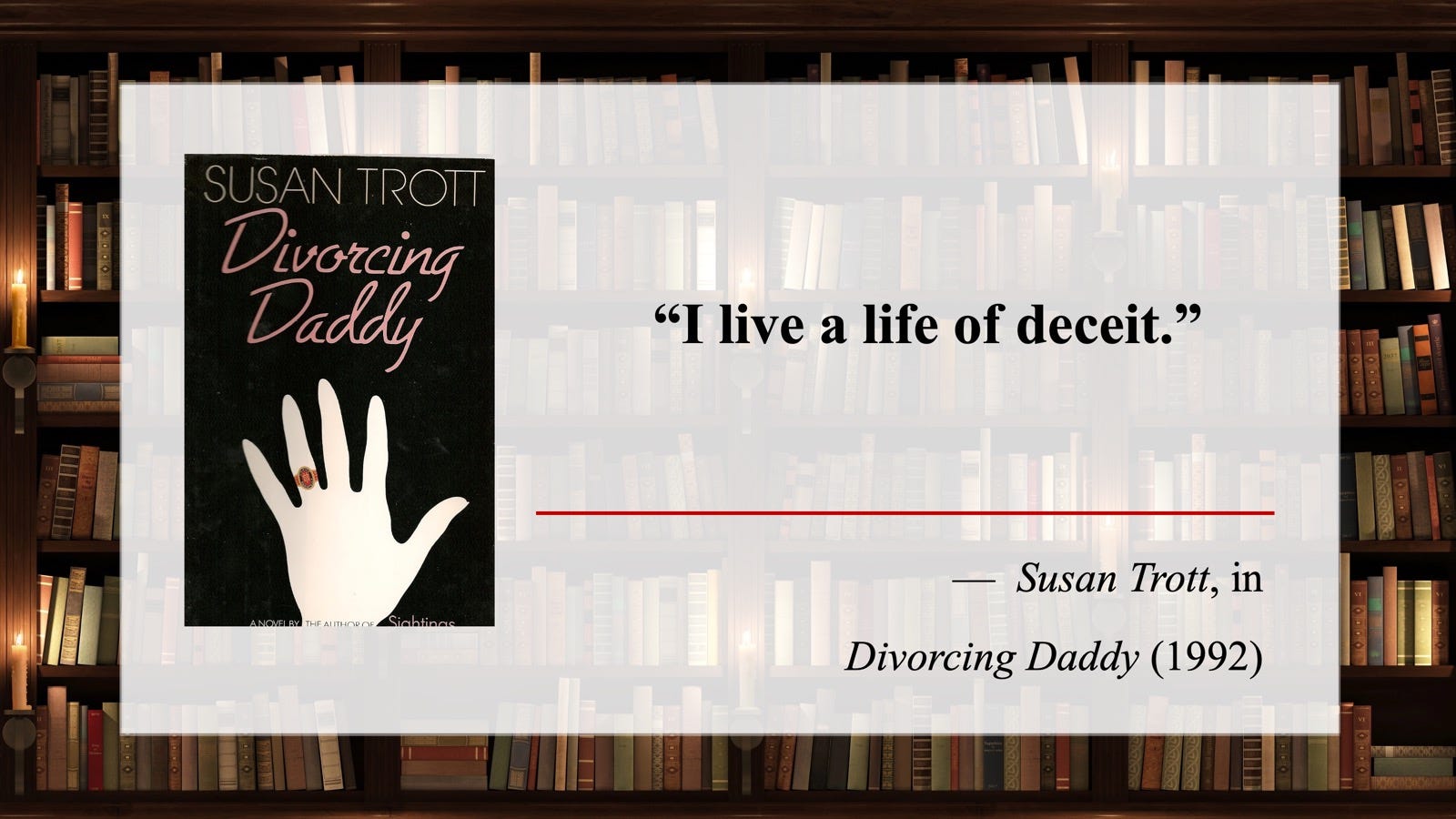
A startlingly blunt confession—especially one built around the emotionally loaded word deceit—makes for a very effective “hook.” What kind of deceit is she talking about, and why has it become a way of life? As the narrator continues in the opening paragraph, she begins supplying the answer—and, in the process, begins to reel readers in:
“My roommate thinks I have a job and I don’t. I get up in the morning and pretend to go to work. I throw on my clothes, grab a bite to eat, a swallow of coffee, and am out the door before Nancy is. Then I skulk around until she leaves the apartment, whereupon I skulk back. I work on my novel all morning, job-hunt in the afternoon, write again in the evening.”
For well over 2,000 great opening lines from every genre of world literature, go to www.GreatOpeningLines.com.
This Week’s Puzzler

On September 21, 1832, this legendary writer died at age 61 in Abbotsford, Roxburgh, Scotland. The son of a Scottish lawyer, he was a voracious reader as a child. He was by no means an introvert, though, for one of his favorite childhood activities was regaling family visitors with detailed historical stories or astounding them with flawless recitations of epic poems.
After a brief legal career, he became one of Scotland’s most influential literary figures, writing great narrative poems like “The Lay of the Last Minstrel” (1805) and “The Lady of the Lake” (1810).
He became known as the father of the historical novel, with Waverly in 1814, Rob Roy in 1818, and Ivanhoe in 1819. In an intriguing historical footnote, he published all these novels anonymously, fearing their publication might harm his reputation as a poet.
He penned some of the most famous lines in the history of poetry, including this immortal observation on this week’s theme:
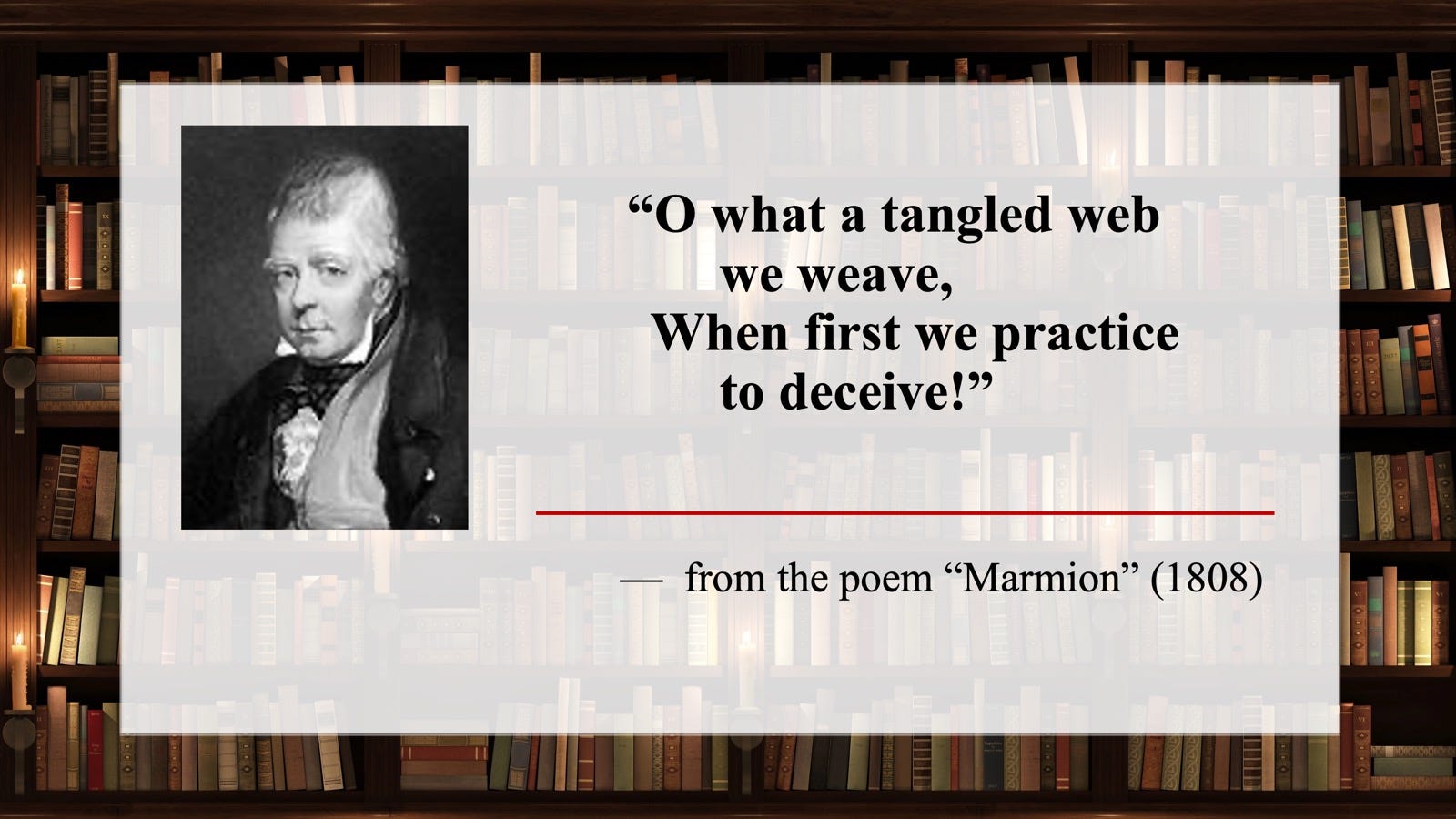
The brilliance of this passage lies in the phrase a tangled web. A deception, once begun, rarely remains a single, isolated event. A first lie frequently requires another to support it, and that additional lie may require yet another fabrication. To complicate matters, details that never really happened must be remembered—which is no small feat. The result is predictable: deceivers become ensnared in the very web they created to deceive someone else.
Who is this person? (answer below)
What Role Have Deceit & Deception Played in Your Life?
According to the American Heritage Dictionary, the word deceit means “to deceive,” and it is defined this way:
“The deliberate concealment or the misrepresentation of the truth.”
The AHD entry on deception doesn’t add much to the discussion: “The use of deceit; the fact or state of being deceived.”
In everyday English, deceit and deception refer to deliberate attempts to mislead other people—usually by presenting something false as true or by preventing them from knowing the truth.
If you say you went to Harvard when you never set foot in Harvard Square, you’re lying. Lying is one common form of deception, but it is hardly the only one. Indeed, much of the deceit and deception in everyday life involves no lying at all. Instead, we withhold a crucial fact, create a false impression, tell a half-truth, exaggerate an achievement, minimize a screw-up, or remain strategically silent when the honorable course would require us to say something.
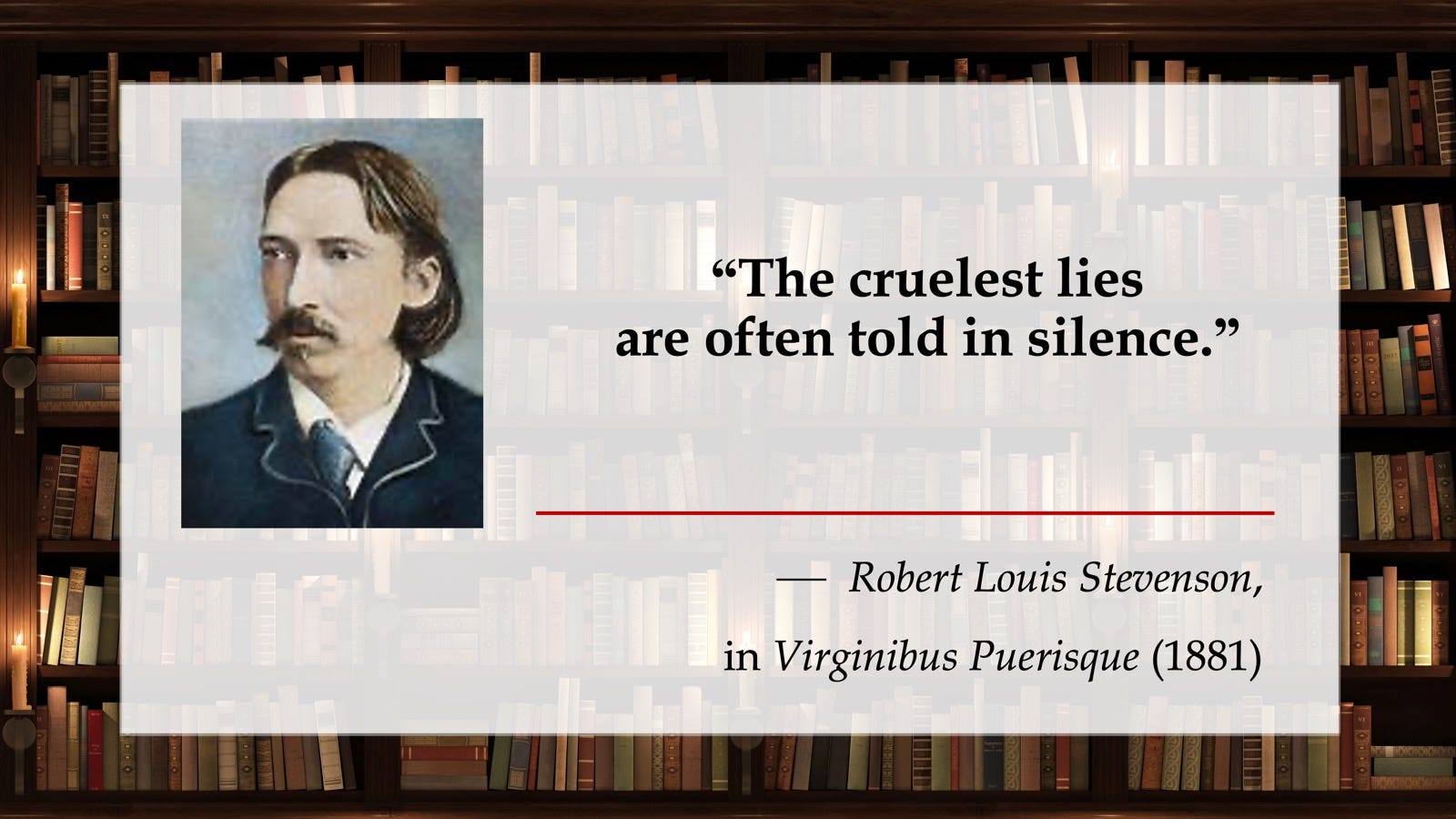
I learned this week that deceit and deception are close relatives, both deriving from the Latin decipere, meaning “to ensnare, entrap, or take in.” This means that long before we spoke of deceiving people with lies and falsehoods, the underlying metaphor was one of ensnaring them. And today, many centuries later, when deception is successful, we still speak of someone being “taken in.”
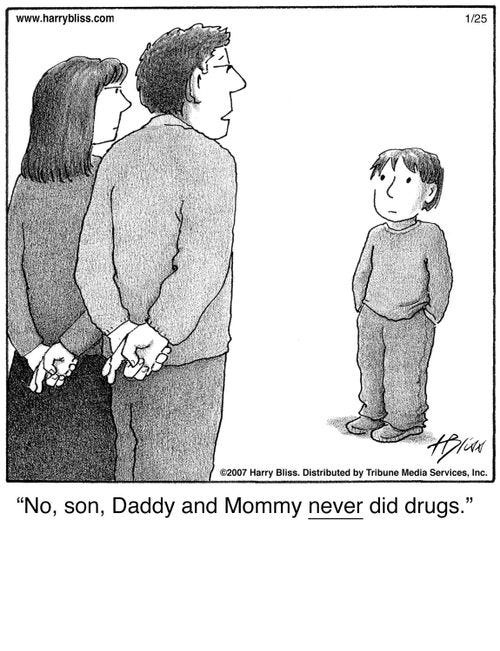
It’s a subject most people don’t talk much about, but deceit and deception are part and parcel of human life. For most of us, it all began in childhood, when we tried to throw our parents off the trail of some questionable activity we were engaging in.
When we grew into adolescence, our capacity for deception also grew. Interacting with my parents during my high school years, I recall being able to concoct elaborate stories almost instantly about where I was going, who I’d be with, and what I’d be doing. It all seemed so effortless.
And then we become adults.
The childhood fibs and adolescent cover stories don’t disappear; they simply take more grown-up forms. And in adulthood, the consequences of deception become far more serious. When we mislead or deliberately conceal important information from a spouse, friend, or loved one, we run the risk of damaging or destroying the very thing that is central to any meaningful relationship: trust. That’s why, when a serious deception is uncovered, the greatest injury comes from the crushing realization that someone we trusted lied to us—or knowingly allowed us to believe something that wasn’t true.
So why do people do it? From the child who denies breaking a window to the husband who conceals an affair, deceit and deception have always offered human beings a tempting way of avoiding unpleasant consequences. But there are other motivations as well. We deceive to protect ourselves, gain an advantage, preserve our reputation, avoid embarrassment, escape an obligation, spare another person’s feelings, or maintain an image of ourselves that we desperately want others to believe.
And sometimes, it should be pointed out, our motives are not entirely selfish. When we tell a gravely ill friend, “You’re looking wonderful,” or pretend to be delighted by a gift we don’t particularly like, we’re engaging in deception motivated by kindness. A surprise party depends on deception. So does a magician’s performance. And anyone who’s ever bluffed at poker knows that some forms of deception are not merely tolerated but expected.
All of which raises an intriguing question: Is deception always wrong?
Clearly, not all deceptions are morally equal. The husband concealing an extramarital affair and the husband secretly arranging his wife’s surprise birthday party are both deliberately keeping the truth from their spouses, but few of us would regard their behavior as morally comparable. To the crucial question Was there deceit or a deception? we would have to add What was the motivation? Who benefited? Who might be harmed? And what would happen to the relationship if the truth were discovered? The last question may be the most important one of all, for the greatest casualty of serious deception is not truth but trust.
Why is Being Deceived So Painful?
And that leads us to one of the most interesting questions of all: Compared to deceiving others, why does being deceived hurt so much more?
One reason is that a deceiver possesses the whole truth, while those being deceived know only the version of the truth that the deceiver has chosen to reveal. This creates an unequal relationship, giving the deceiver the power to manipulate another person’s understanding of reality.
This kind of imbalance becomes especially consequential in our closest relationships, where we are most vulnerable. When we discover that someone we love—a spouse, family member, or close friend—has deliberately misled us, more than a single falsehood is exposed. A bond of trust has been broken, and our confidence in the relationship itself is shaken. We don’t merely ask, Why did you lie to me? We begin asking more troubling questions: What else have you lied about? And what else have I believed that might be false?
And therein lies one of the cruelest ironies of deceit: the more completely we trust someone, the more completely that person may be able to deceive us—and the more deeply the deception hurts when it is finally revealed.
This week, think about the role that deceit and deception have played in your life—whether you served as the perpetrator of the deception, or the victim. As you approach the assignment, let your thinking be stimulated by this week’s selection of quotations on the subject:
Deceit and violence—these are the two forms of deliberate assault on human beings. — Sissela Bok
There are some frauds so well conducted that it would be stupidity not to be deceived by them. — Charles Caleb Colton
No one is ever warmed by wool pulled over his eyes. — Marcelene Cox
There is no killing the suspicion that deceit has once begotten. — George Eliot
Deception and ‘con games’ are a way of life in all species and throughout nature. Organisms that do not improve their ability to deceive—and to detect deception—are less apt to survive. — Harriet Lerner
It is easier to deceive than to undeceive. — Napoleon I
Not that you lied to me, but that I no longer believe you, has shaken me. — Friedrich Nietzsche
The essence of lying is in deception, not in words. — John Ruskin
All deception in the course of life is indeed nothing else but a lie reduced to practice, and falsehood passing from words into things. — Robert South
Women might be able to fake orgasms, but men can fake whole relationships. — Sharon Stone
It is not difficult to deceive the first time, for the deceived possesses no antibodies; unvaccinated by suspicion, she overlooks latenesses, accepts absurd excuses, permits the flimsiest patchings to repair great rents in the quotidian. — John Updike
For source information on these quotations, and many others on the topic of DECEPTION & DECEIT, go here.
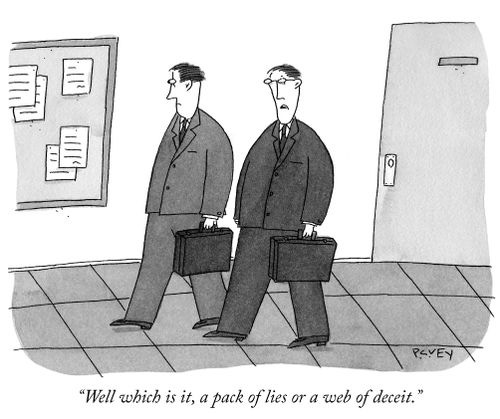
Cartoons of the Week
Answer to This Week’s Puzzler
Sir Walter Scott (1771–1832)
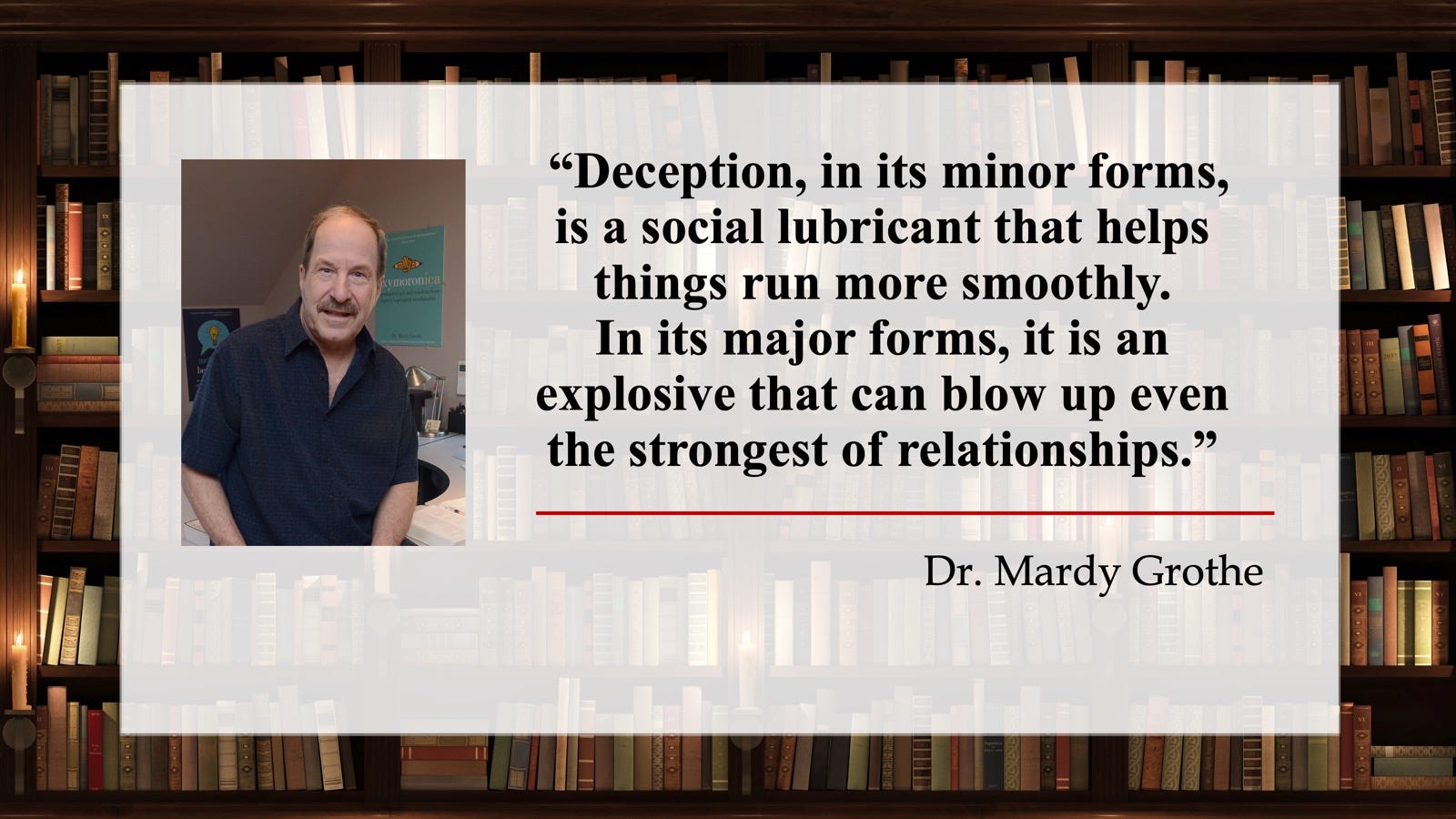
Dr. Mardy’s Observation of the Week
Thanks for joining me this week. See you again next Sunday morning.
Mardy Grothe
Websites: www.drmardy.com and www.GreatOpeningLines.com
Regarding My Lifelong Love of Quotations: A Personal Note
At the risk of sounding like a "Goody Two-Shoes," I have 'way too poor a memory to lie or try to deceive anybody. I remember being outraged at one of my husbands by being accused of lying about something. "Who the hell do you think you are that I would lie to you! I'm not afraid of you!" I don't remember what he thought I lied about, but it really made me mad. Lying is too exhausting. Truth, many times hard to admit, makes things easier to forgive, human frailty and all that.
Thanks Mardy for another interesting write. I was wondering recently about the tangled web comment. I thought it might have been in one of Shakespeare"s plays, but I never looked it up. Now I know where it came from. It's one of my favorite sayings. Your post about trust made me think about "the boy who cried wolf." That used to be true in most cases, but nowadays you see some people following others no matter how many lies they tell. Shows you what too much adulation and idolatry can do.