
Great Opening Line of the Week
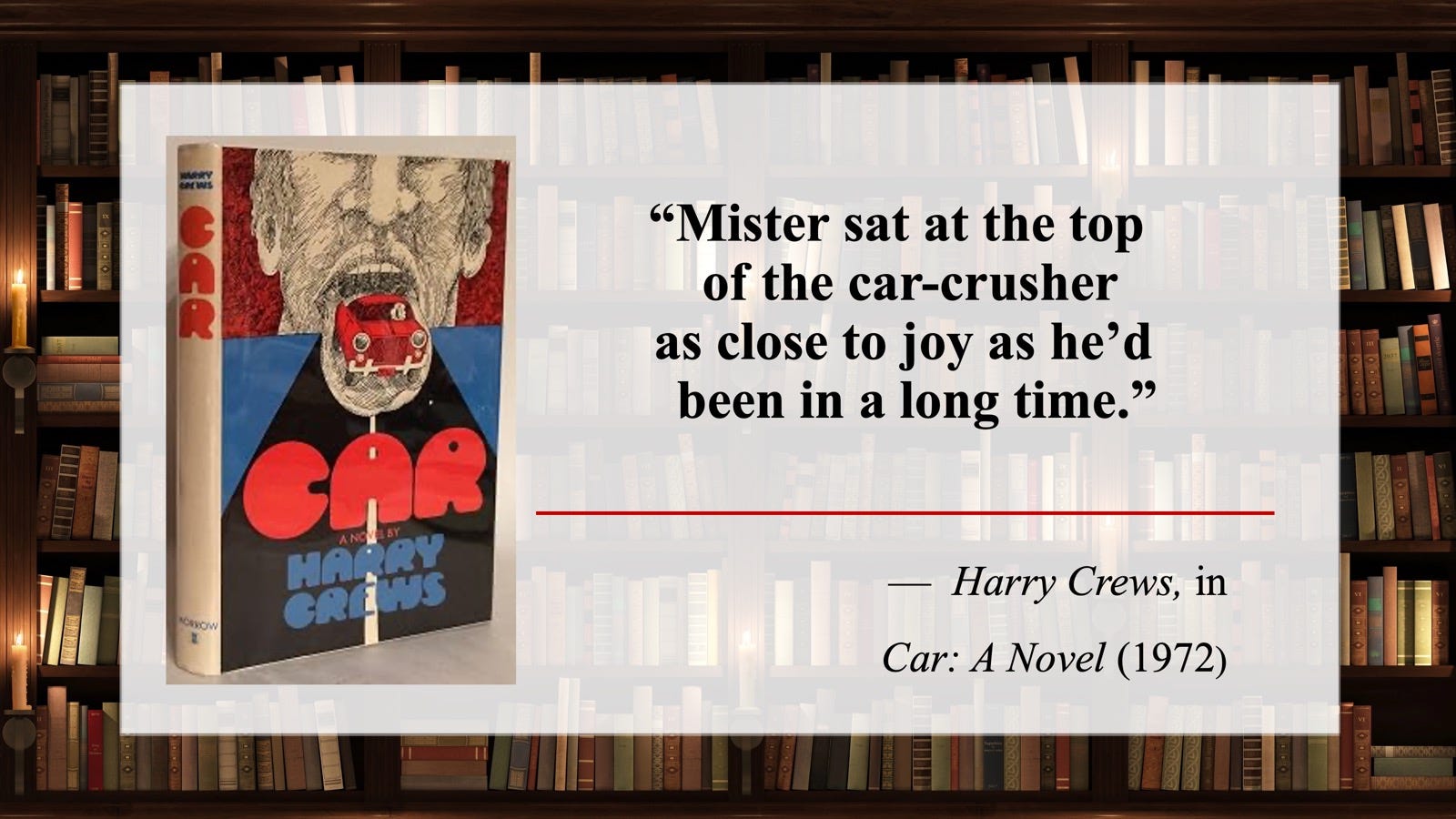
The image of a man perched atop a car-crusher is arresting enough, but the real surprise comes in the final words of the opening line. What kind of man finds joy in a machine designed to destroy automobiles? And what has happened in his life to make such an unlikely setting a source of joy? In a single sentence, the narrator gives us an unforgettable image, a tantalizing glimpse into a character’s inner life, and two compelling reasons to keep reading.
The image of Mister joyfully perched atop a car-crusher also immediately establishes the peculiar mixture of dark humor and social satire that characterizes the novel.
For more than 2,000 memorable opening lines from every genre of world literature, go to www.GreatOpeningLines.com.
This Week’s Puzzler

On October 31, 1987, this man died at age 83 in Honolulu, Hawaii. After his death, a Newsweek obituary said he’d “become one of the rarest intellectuals in American life: a serious thinker who has been embraced by the popular culture.”
Born in 1904 in White Plains, New York, he grew up in a middle-class Irish Catholic family. In 1911, at age seven, he saw Buffalo Bill’s Wild West Show in Madison Square Garden. He immediately became so fascinated with Native American folklore that he spent much of the next decade reading anthropological journals and prowling through the exhibits of the American Museum of Natural History.
His interest in folklore and mythology continued into his college years, first at Dartmouth College and then at Columbia University, where he received a B.A. in English literature (1925) and an M.A. in medieval literature (1927). While in college, he was a true scholar-athlete, becoming one of the era’s fastest half-mile runners as well as excelling in the classroom. After studying in Europe for a few years, he returned to America just after the Great Depression began.
In 1934, he accepted a teaching position at Sarah Lawrence College, and he went on to entrance students with his dazzling lectures until his retirement in 1972. With books like The Hero with a Thousand Faces (1949) and Masks of God (four volumes, 1962-1968), he established a worldwide reputation as a scholar and mythologist. In 1985, he achieved a kind of guru status when Bill Moyers introduced him to the world in his PBS-TV series, The Power of Myth.
In my personal quotation collection, I have scores of thought-provoking
observations from this week’s Mystery Man, including this one:
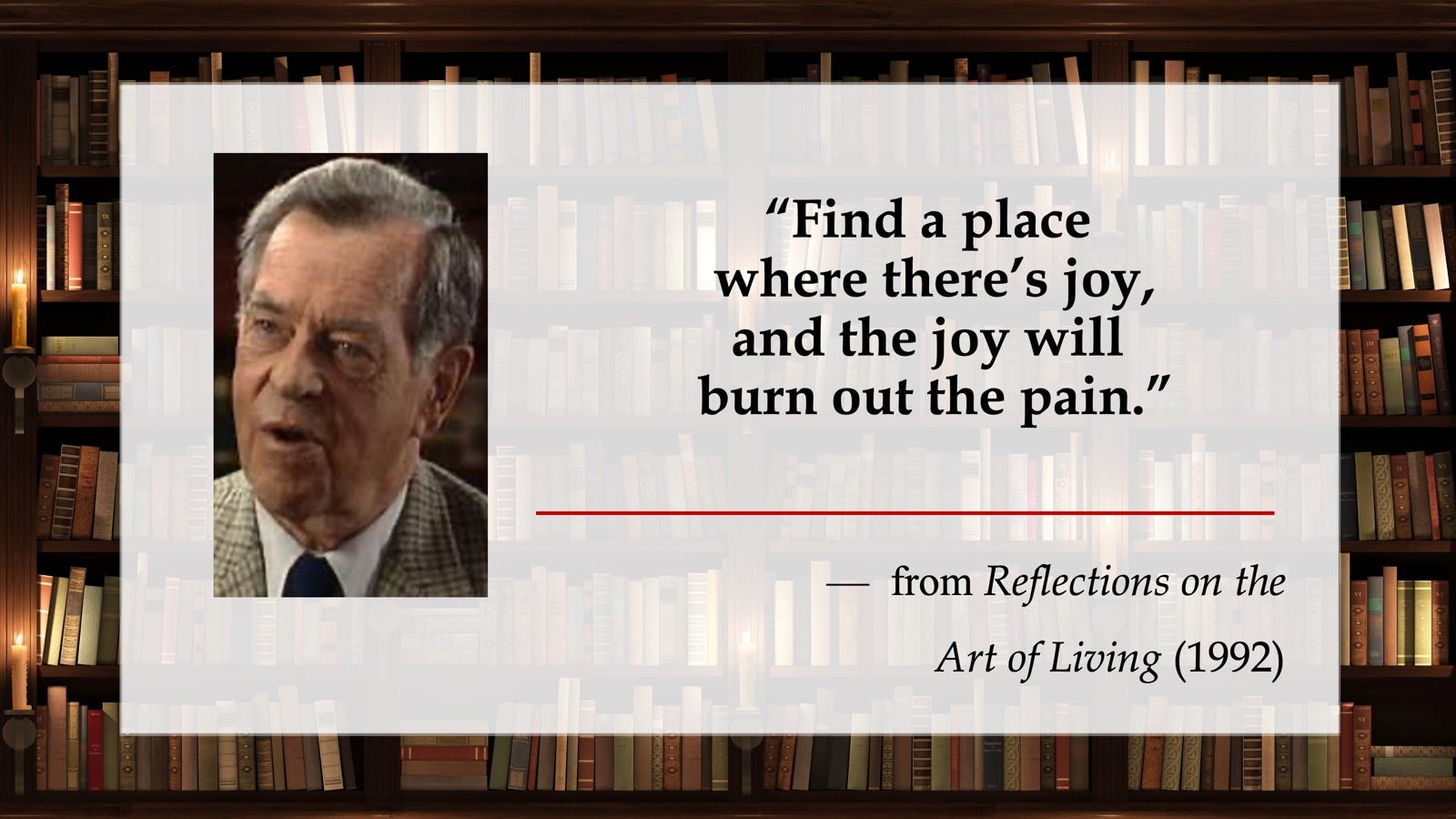
Who is this person? (Answer below)
Where Have You Found Joy in Your Life?
Where have you found the greatest joy in your life? It’s a simple question, but answering it thoughtfully usually reveals something important about who we are, what we value, and how we’ve chosen to live our lives. First, though, let’s be clear what we’re talking about when we use the word.
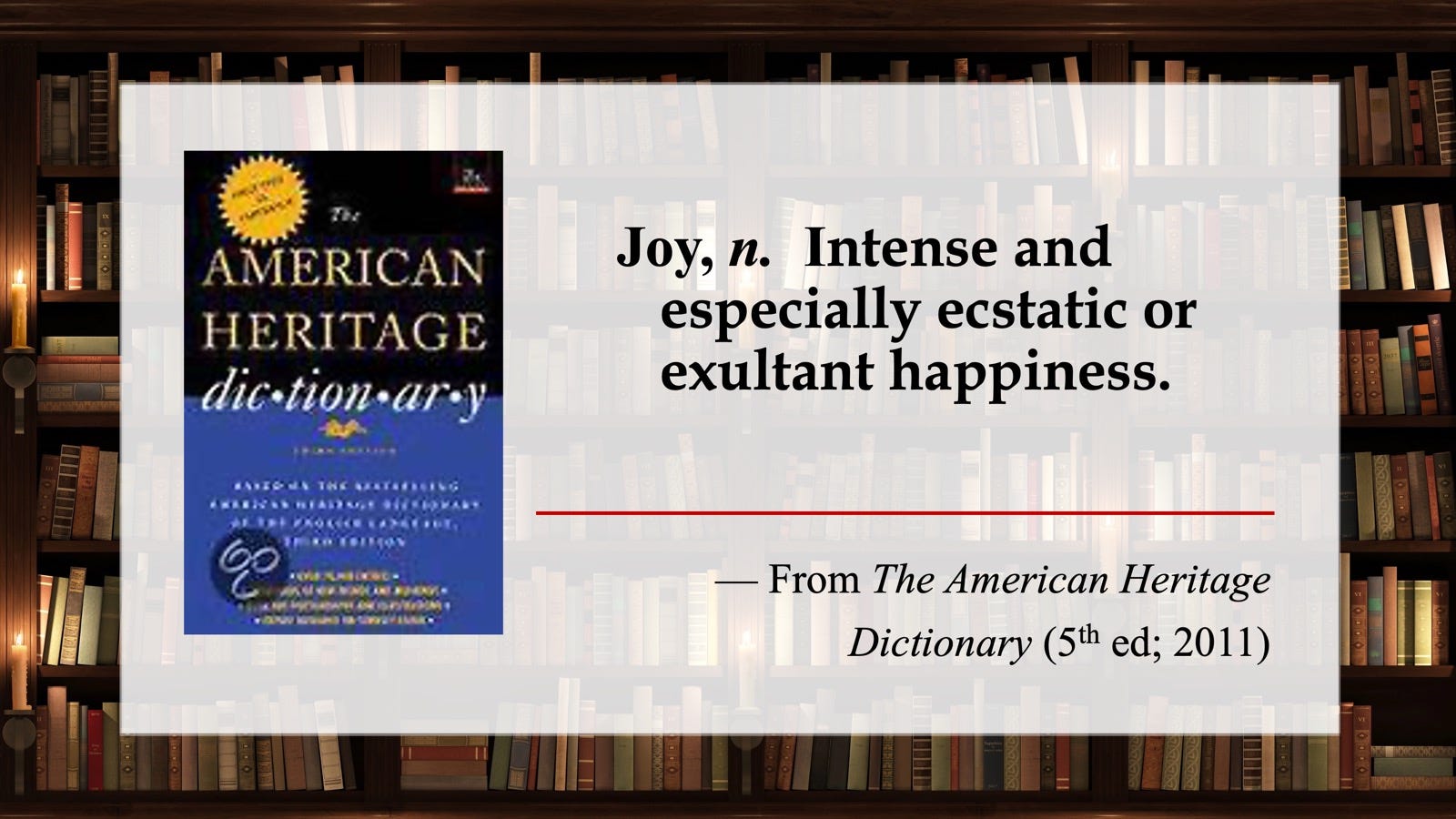
This beautifully phrased definition comports with the average person’s understanding of the word, which views joy as going well beyond pleasure, delight, or ordinary happiness. When compared to these other pleasant states, according to the AHD editors, “Joy suggests an intense and especially exultant or ecstatic state; the word is often associated with sharing, self-realization, or high mindedness.”
Although joy and happiness are often used interchangeably, the two words are not synonymous. Happiness encompasses everything from mild contentment to great delight. Joy suggests something more intense, more deeply felt, and more enduring in its significance. A few years ago, I even recall someone describing joy as “happiness on steroids.”
According to the American Etymological Dictionary, the word joy entered English in the early 13th century, deriving from the Old French joie, meaning “pleasure, delight, or bliss.” The French word ultimately traces to the Latin gaudium, meaning “joy or gladness,” and gaudere, meaning “to rejoice.”
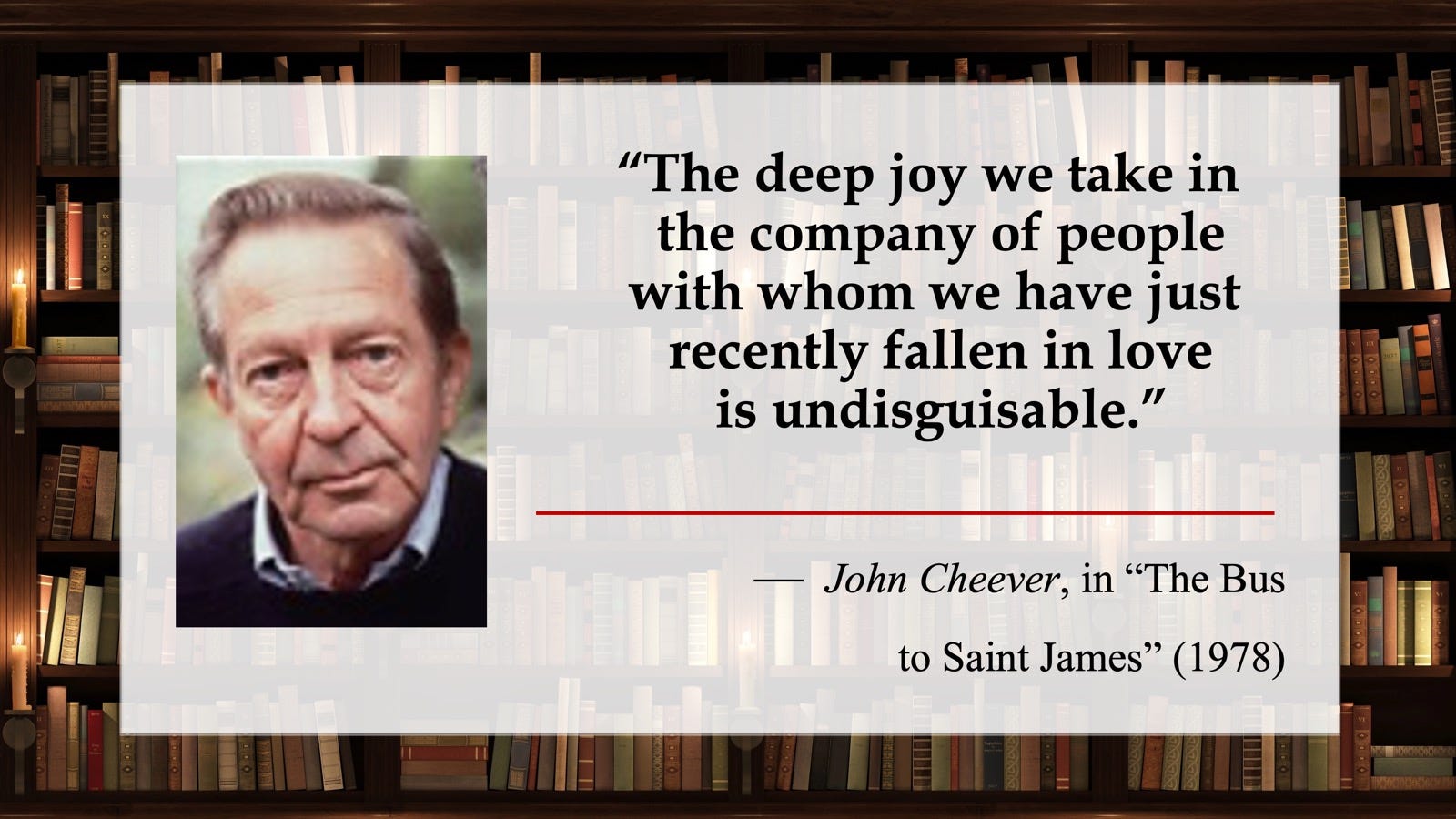
For many people, joy is closely associated with the exhilarating experience of falling in love. The novelist John Cheever memorably captured this feeling in a 1978 short story:
But romantic love is only one of the many ways joy enters our lives. Parents often describe the birth of a child as one of the most joyful experiences of their lives. Musicians experience joy when a performance achieves an almost transcendent quality. Athletes find it in those extraordinary moments when mind and body seem to operate in perfect harmony.
And then there are the quieter forms of joy: the kind of deeply felt satisfaction of mastering a difficult skill, creating something beautiful, having an especially meaningful conversation, or doing something we love so completely that we lose all awareness of time. These experiences may look different on the surface, but they share one important characteristic. They make us feel intensely alive.
For this week’s Mystery Man, when we feel intensely alive, we connect with our deepest selves. He called such places sacred spaces, and said about them:
“Your sacred space is where you can find yourself again and again.”
A sacred space is like a religious sanctuary, but it looks nothing like a church, synagogue, or mosque. It can exist in your home office, a basement workspace, a studio above the garage, a writer’s nook, a local library or museum, or a park, garden, or walking trail. Even more important, it might not be a physical location at all, but rather a deeply absorbing activity that brings you into contact with something so personally meaningful that it becomes transcendent.
This week’s Mystery Man expanded on the idea in a passage I’ve returned to many times:
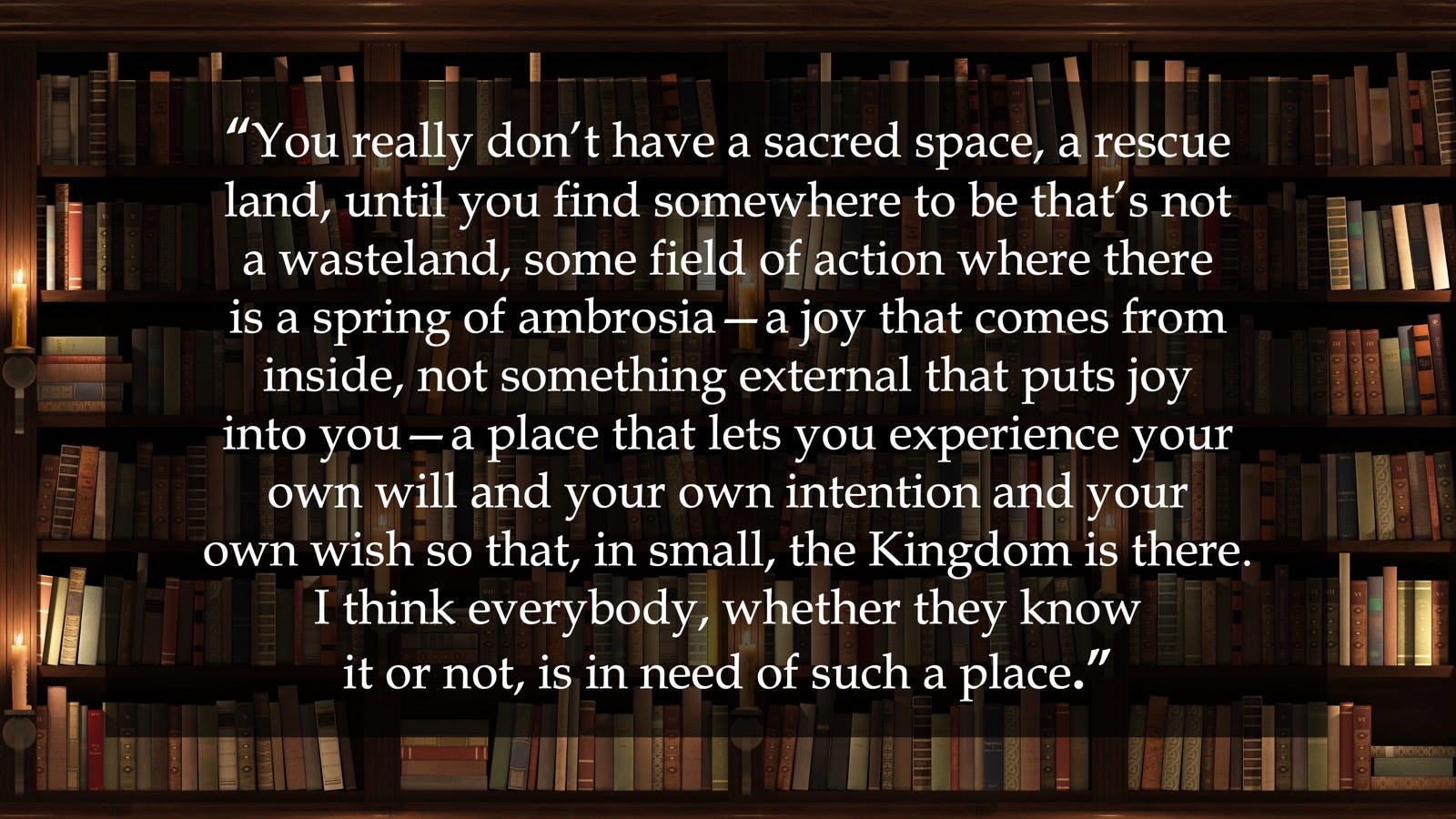
This is one of the most beautiful passages I’ve ever encountered in my reading, and the expression a spring of ambrosia is especially evocative. In Greek mythology, ambrosia was the food of the gods, associated with immortality and divine existence.
To my mind, our Mystery Man is talking here about nourishment for the soul. Yes, we can purchase pleasures, arrange enjoyable experiences, and surround ourselves with things that make life comfortable. But the kind of joy he’s describing can be neither bought nor bestowed. It must be discovered first, and then purposely cultivated. Once we learn how to do that, we can return to it again and again.
For me, the world of quotations has been such a place.
For more than six decades, I’ve had the extraordinary good fortune to inhabit that wondrous world (you can see where it all began by going here). What began as a fascination with the insightful and beautifully expressed thoughts of Henry David Thoreau and other great thinkers gradually became a lifelong passion, a source of intellectual stimulation, and one of the most enduring pleasures of my existence.
Even after all these years, I still experience a thrill when I discover a quotation that expresses a familiar truth in a clever, memorable, or entirely unexpected way. Sometimes it’s a dazzling metaphor. Sometimes it’s a brilliant example of wordplay. And sometimes it’s an observation that so beautifully captures a truth about the human condition that I wonder how the author managed to see something the rest of the world had overlooked. Over the decades, I’ve spent countless hours pursuing such discoveries, often becoming so absorbed that I scarcely notice the passage of time.
It is also true that the joy I experience in my sacred space is magnified greatly when readers write to tell me that a quotation has changed the way they think about something, helped them through a difficult period, or given them a new appreciation of something important in life. There’s nothing in the world quite like the experience of not merely discovering something valuable, but sharing it with others.
Which brings us back to the question I posed at the beginning of this week’s post: Where have you found the greatest joy in your life?
Has it come primarily from your relationships with other people? From the work you’ve done? From the pursuit of a dream? From artistic expression, intellectual effort, or some other activity that makes you feel especially alive? If you’ve discovered a sacred space of the kind described earlier, consider yourself very fortunate, for you’ve found something that many people spend their entire lives searching for.
And if you haven’t, remember that your journey is not over. Somewhere ahead may exist a whole new world of possibility for you. But don’t wait for it to find you; it’s the kind of thing you have to discover for yourself. As you contemplate the subject this week, let your thinking be stimulated by this week’s compilation of quotations on the subject.
When large numbers of people share their joy in common, the happiness of each is greater because each adds fuel to the other’s flame. — St. Augustine
There is no beautifier of complexion, or form, or behavior, like the wish to scatter joy and not pain around us. — Ralph Waldo Emerson
It’s easier to write about pain than about joy. Joy is wordless. — Erica Jong
Joy is the holy fire that keeps our purpose warm and our intelligence aglow. — Helen Keller
Men without joy seem like corpses. — Käthe Kollwitz
Joy is the best makeup. Joy, and good lighting. — Anne Lamott
Joy, rather than happiness, is the goal of life, for joy is the emotion which accompanies our fulfilling our natures as human beings. — Rollo May
Joy seems to me a step beyond happiness—happiness is a sort of atmosphere you can live in sometimes when you’re lucky. Joy is a light that fills you with hope and faith and love. — Adela Rogers St. Johns
This is the true joy in life, the being used for a purpose recognized by yourself as a mighty one; the being thoroughly worn out before you are thrown on the scrap heap; the being a force of Nature instead of a feverish selfish little clod of ailments and grievances complaining that the world will not devote itself to making you happy. — George Bernard Shaw
One filled with joy preaches without preaching. — Mother Teresa
For source information on these quotations, and more observations on the theme of JOY, go here.
Cartoons of the Week:


Answer to This Week’s Puzzler:
Joseph Campbell (1904-87)
Campbell also offered these thoughts on this week’s theme:
“The conquest of the fear of death is the recovery of life’s joy.”
“We cannot cure the world of sorrows, but we can choose to live in joy.”
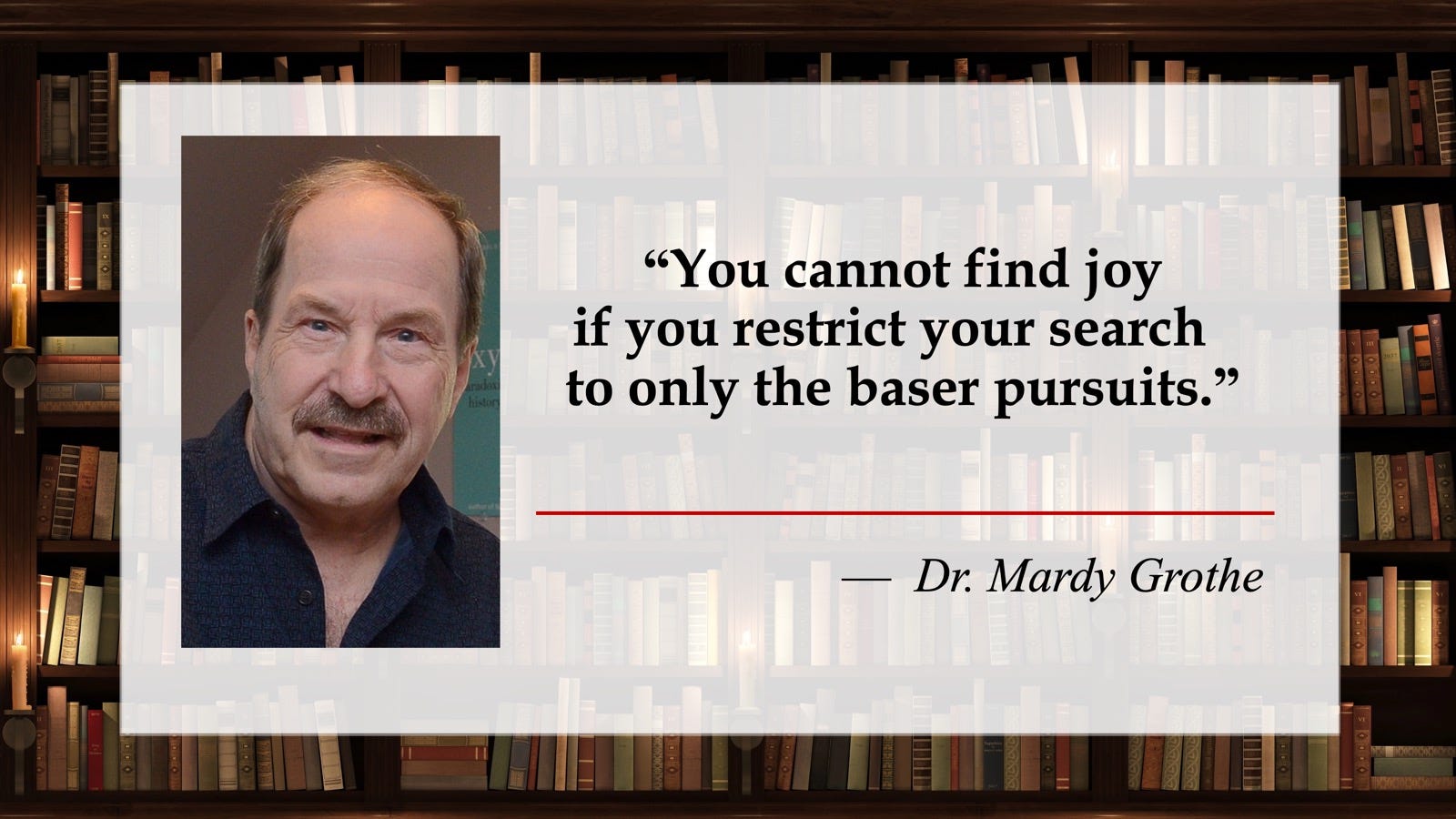
Dr. Mardy’s Observation of the Week:
Thanks for joining me again this week. See you again next Sunday.
Mardy Grothe
Websites: www.drmardy.com and www.GreatOpeningLines.com
Regarding My Lifelong Love of Quotations: A Personal Note
Joy for me is found in nature: the pattern of red trident maple leaves on dark wet pavement. The glorious pattern of seagulls flying and calling above my head on my favorite beach. And the tending of my garden while listening to intensely touching music. As a teen I would seek out blissful moments during trips in the High Sierra. Thank you for this topic.
Well, this one's easy. Ever since I can remember, my joy has always been music, whether in listening to it or playing it or singing it. After abandoning it for almost 30 years - faithless lover! - I met Jack and found joy and love again in our jazz quartet. Even now, with shriveled vocal cords and arthritic fingers (and much, much practice), I find some joy again by introducing the younger generation to songs they might never hear of otherwise. How do you always think of such perfect themes, Mardy?